
To me Emilio Pucci’s fashion is connected very much to Marilyn Monroe, wearing colourful Pucci garments for photo shoots in the early 1960s, radiating vitality shortly before her death.
Reading through the books on Emilio Pucci, a general theme of his fashion was to make women happy with his designs and to give them strength.
Just looking at the colours makes you smile. It is almost impossible not to feel the zest for life in those designs. The quotes in the books tell of joy, freedom, modernity, seduction, and style amongst others. For beautiful and difficult moments many of the ladies lucky enough to own Pucci cloths decided to wear them, like a suit of armour made of silk.
Italian nobleman Marchese Emilio Pucci di Barsento was born 1912 in Naples. Strangely not in Florence, the city where his ancestors had lived for generations and where he lived most of his life. He studied, amongst other subjects, political science and made his PhD. During his youth he discovered his interest in the USA, first as part of a national ski team, then as a student. His family was not happy when he set up a fashion boutique on the island of Capri in 1948. Emilio Pucci wanted to work in a hands-on-business, one reason being that the money of his family was more or less gone (apart from buildings and land, of course. Probably there was more left than we might think). Out of sensitivity for his family he signed his designs usually only with his first name. When the fame had grown great, the use of his family name was accepted by everyone. Emilio Pucci did already have initial experiences with clothing designs from his years in the USA, before he became a ‘real’ designer on Capri.
His business expanded fast, first to Rome, then to the USA. The 1960s were his decade through their unique blend of traditional elegance and a spirit of optimism. The 1950s were still very conservative and the 1970s often lacked the elegance of the years before, but embraced freedom. For Emilio Pucci the path always led upwards. He ran his company till his death in 1992. Afterwards, his daughter took over and within time, LVMH came in and is today the owner of the Emilio Pucci company.
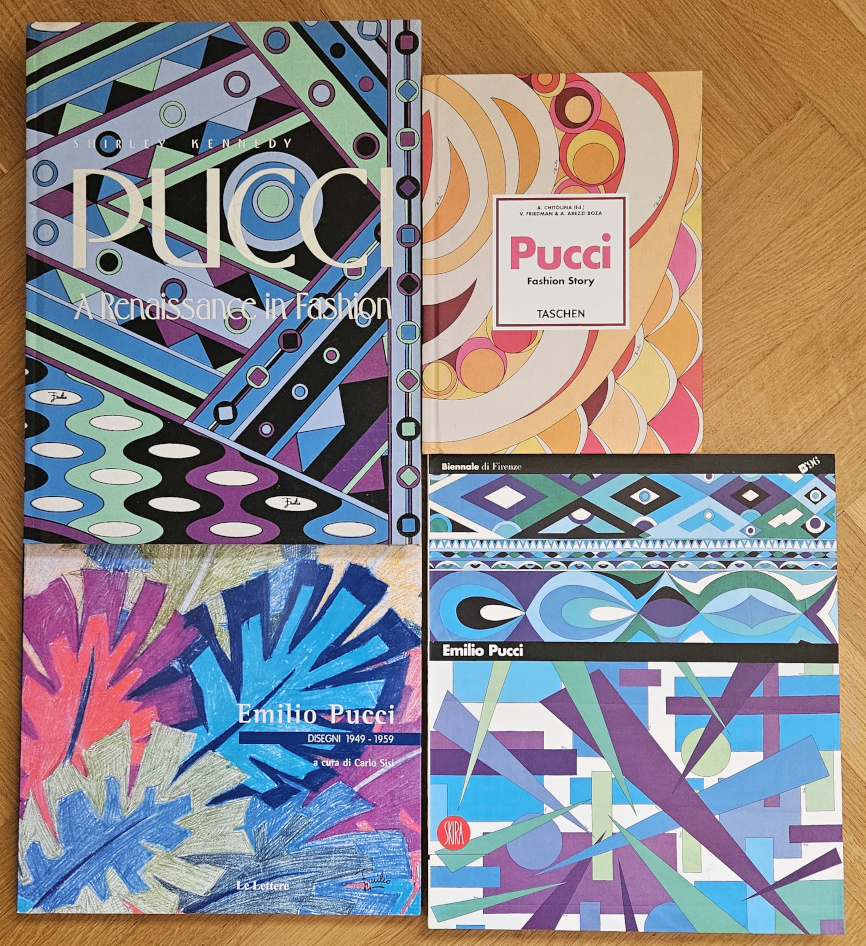
As you can see on the covers of the books used for this post, Emilio Pucci’s designs were all about geometrical forms and perfect combinations of colours. It is quite fitting that none of the books had a real dress on the book cover, but abstract geometrical designs in colour schemes of turquoise and orange. Seeing such a combination on dresses, blouses, skirts and pants makes everybody immediately think of Emilio Pucci. There is one exception, the book that concentrates on his drawings between 1949 – 1959. Still, the colourful drawing of leaves easily could become the basis for one of the later designs.
Inside the books, photographs show the Pucci garments worn and showcased in their natural environment of the city of Florence. The similarity of the geometry of the dresses to that of the Renaissance buildings like the Duomo and of palaces is breathtaking. Same goes for mosaics and frescos in Florence and other Renaissance cities. Emilio Pucci made it possible to translate architecture in fashion. There are similar cases with other designers e.g. for Venice. Whenever a true artist with a wealth of knowledge about a city and the city’s culture running through his/her veins creates something like this, magic happens.
Although today Emilio Pucci’s company is not any longer owned by the family, the newest designs seem very well in line with the founder’s ideas. I just surfed a bit on the Pucci website and got the impression that the spirit of Emilio Pucci is still there. Woman’s clothes dominate, but there are also other articles.
Is today just as perfect a time for Emilio Pucci’s designs as it was in the 1960s? Probably not. But it is the advantage of today’s overwhelming abundance of fashion and the pronounced individualism that prevails everywhere, that a fashion house with a very brave history, like Pucci, almost seems to have the right to survive. There is no need to dominate everything, but it is wonderful to be present in the world and stay there.
The more complicated the world gets, the more important become the people who bring optimism. Be it in fashion, scents, books or any other way. Emilio Pucci was a role model not only for accepting change in his own life, but for creating fashion that oozed optimism and cheerfulness. Luckily, his designs will stay on.
All rights to the books belong to:
Biennale di Firenze: Il Tempo de la Moda, Emilio Pucci, 1996, published by Skira editore, printed by Europrint, Treviso Italy, ISBN 88-8118-116-9
Chitolina, A. (Ed.), Friedmann V., Arezzi Boza, A.: Pucci, Fashion Story, 2026 (original edition 2010), published by TASCHEN, Hohenzollernring 53, D-50672 Koeln, printed in Bosnia-Herzegovina, ISBN: 978-3-7544-0020-3
Kennedy, Shirley: PUCCI, A Renaissance in Fashion, 1991, published by Abbbeville Press, Inc. 488 Madison Avenue, New York, NY 10022, printed and bound in Japan, ISBN 1-55859-057-9
Sisi, Carlo: Emilio Pucci, DISEGNI 1949-1959, 2004 (prima edizione), published by Le Lettere – Archivio Pucci, printed by ABC tipografia s.r.l., Firenze, Italy, (a book about the exhibition in the Galleria del Costume di Palazzo Piti, Firenze, 23.06.2004-30.09.2004), ISBN 88 7166 942 8