

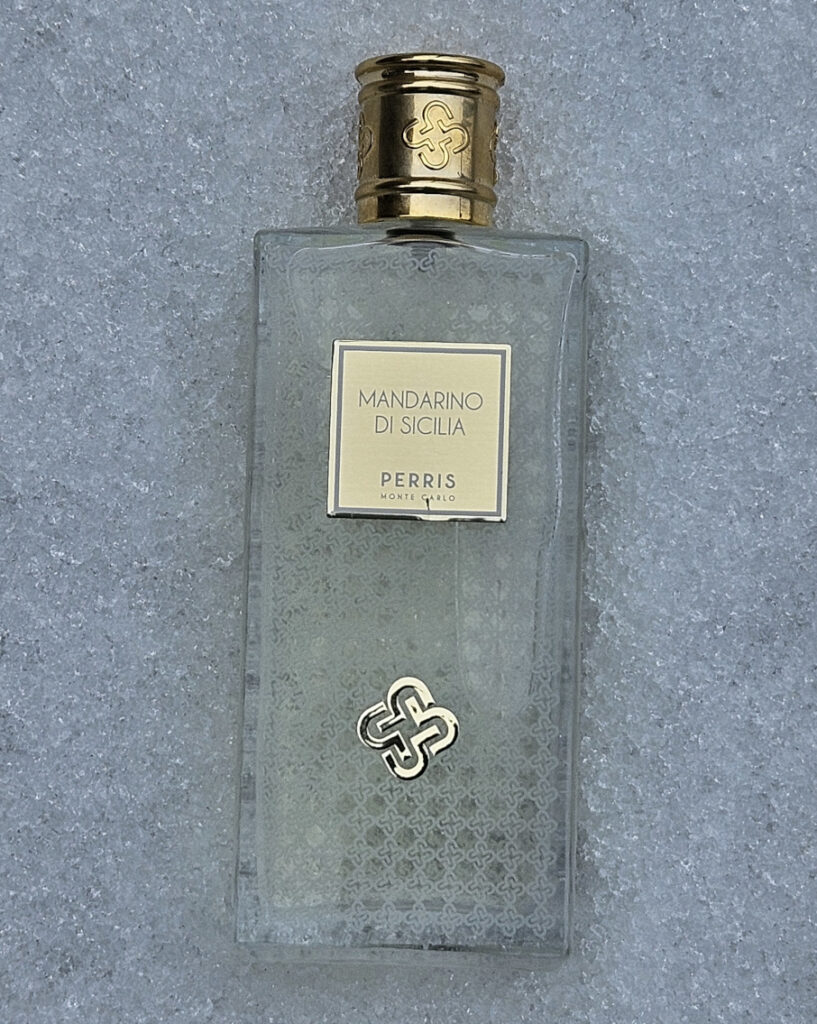
“Mandarino di Sicilia” is like the first greeting from spring, whilst snow and ice are still ruling the outside world. The best mandarins grow during wintertime; they reach their highest quality between December and February. With their colourful appearance they seem to be the antidote to winter, orange and green being very different to grey and white. Winter in Sicily or Spain, where many of the European mandarins are produced, does not come as hard as in the Northern countries, it is much rainier and less icy. But we can see the connection between the colourful sweet-sour fruits and their chilly time for growth. Mandarins do not need to be orange to be sweet, they can also have green spots without quality loss. The mandarin tree stays green all year round.
It was Perris Monte Carlo’s aim to bring the scents from the mandarin peel, the flesh, the flower, and the full life cycle of the fruit all together into one perfume, as they explain on their website. They reached their goal quite well. The initial smell is the one when you rub a mandarin’s peel or when you remove it. A slight bitterness mixes with sweetness and later sourness, all very close to the real fruits. One could say the perfume smells like mandarin jam, cooked with the peel. The melting scent notes and the overall fresh sensation make “Mandarino di Sicilia” such a nice reminder of the warmer times to come.
According to Perris Monte Carlo’s website the main scent notes are green mandarin Capua, bitter orange, yellow mandarin, and petitgrain Paraguay for the head impression. Jasmin absolute, geranium, and orange blossom follow for the heart notes. The base is made of cedarwood, amber, and musk.
The top notes dominate the fragrance for a long time. If you leave a cloth (sprayed with the perfume) lying around and sniff it the next day, the top scent is still there, but it has become much warmer and softer and goes in the direction of perfumes that are made with the sweeter orange instead of the mandarin. Of the described heart notes I smell nothing, the base note are the reason for the softer perfume finish.
The durability and sillage of “Mandarino di Sicilia” are only medium. The perfume is unobtrusive and stays in the background, but gives a certain elegant touch of freshness.
The colour of the scent is a sparkling pale green.
Mandarins, originally, come from South East Asia and surprisingly those little fruits are the grandfather fruit of all orange-citrus species. Mandarins were known in Asia for 1000s of years before they arrived in the early 1800s in England. England was back then the centre of the Western world, the East Indian Company the bearer of everything exotic and expensive. From England the mandarins were soon exported to regions in Europe where they could naturally grow. Not long after, Sicily became known for their quality mandarins. It is surprising to hear that oranges came to Europe already in the 15th century, with the then in Asia dominating Portuguese. Their cultivation was in the beginning limited to Portugal, but with some time the fruits conquered all Southern Europe.
To summarize this complicated citrus history: all orange citrus species apart from the clementine come from Asia, are grandfathered by the mandarin, and came to Europe only during the last few centuries, already diversified in blood oranges, oranges, mandarins and so on. Only the clementines were really born in Southern Europe.
Perris Monte Carlo is a famous name in the niche fragrance world. The brand was established in 2011 by Gian Luca Perris as part of the Perris Group. Michele Perris, who founded the Perris Group in 1981, worked very closely with the established perfume house Houbigant. His first business was the distribution of Houbigant scents. The story of Houbigant is an intriguing one over centuries. For us here it is mainly important that today the Perris Group are the de facto heirs to Houbigant and Alyssa Ashley. Alyssa Ashley is a brand tied through family connections to Houbigant. However complicated the histories of the Perris and the Houbigant families may be, there was great working relationship between Michele Perris and the last heirs of Houbigant. When the latter decided to sell their company, the Perris family stepped in and bought it. Today all the brands exist under the roof of the Perris Group and each has kept their own identity. Skincare and 3-D-printing show how differentiated the products of the Perris Group have become. The Perris family is very proud of their technological approach combined with traditional methods.
All brands of the Perris Group seem to be doing well and we need not fear that beloved scents are suddenly gone from the market. There is no inflation of new perfumes by Perris Monte Carlo. Each new perfume is carefully crafted. As with other brands that are firmly family owned, the future for them seems bright. If common sense, tradition, new inventions, and careful business acumen are combined, all is going well.
“Mandarino di Sicilia” is a typical product of Perris Monte Carlo. The perfume is part of the relatively new Italy collection. Having bought by now a range of Perris Monte Carlo perfumes, their overarching similarities are: precise description of what the scent is about, a mixture of very pure and carefully selected ingredients (“Vanille de Tahiti” is a prime example) and an understated elegance of the fragrances. It will be interesting to see which part of the world they bring to us in the form of perfumes next.