
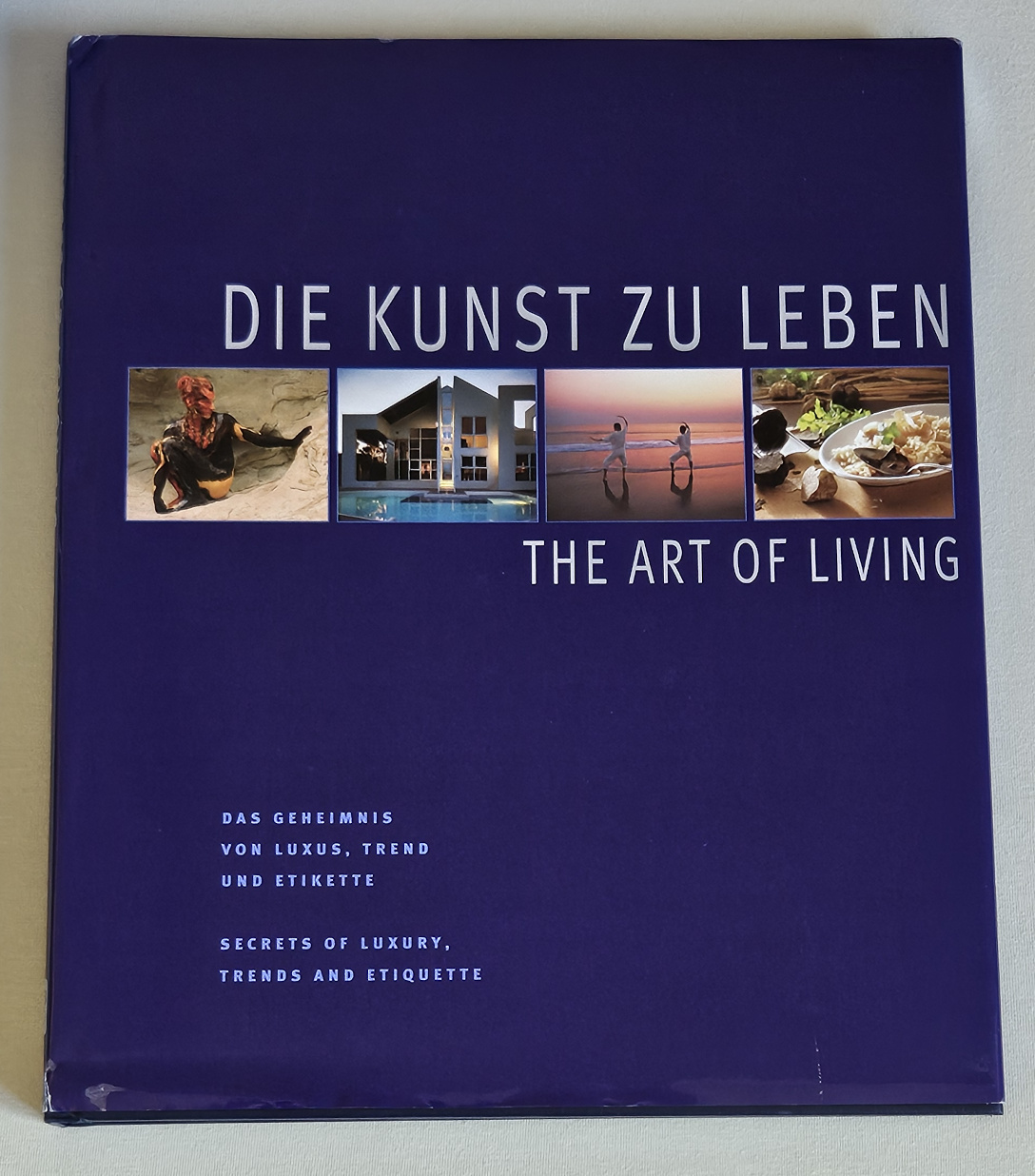
This very special book came to my shelves in a quite normal way, through amazon, a blind-buy because I liked the title. Only when reading it I noted that “The Art of Living, Secrets of Luxury, Trends and Etiquette” cannot be bought through regular channels. It is part of the oeuvre of the Olympische Sport Bibliothek, founded in 1972 in Munich, and these books are created on demand only and sold by special sales partners.
I do not know by whom this book was ordered and for which audience. I only know that it was published in 2001, therefore reading it means to travel 25 years back in time. Some of the chapters look into the future – this indeed is fascinating. Some things the authors got quite right, others clearly not. Looking back, in 2001 mobile phones were just becoming a mass phenomenon, the idea of artificial intelligence was still science fiction, the same as space tourism. On the other hand, predictions on these topics seem clearer than the chapters that deal with old human questions like ageing, what it means to win etc.
The content is unusual, a combination of topics that show no common thread. It sounds as if someone decided to have a book written on all the topic’s that this individual thought interesting. Maybe this is exactly how the book came about – we will not know. If there is one guess allowed, then that the individual worked in marketing. This topic comes up repeatedly.
The content overview can be read like an agenda for good living: the chapters are named ‘live and let live’, ‘sacrifice, victory, marketing’, ‘the inner talkshow’, ‘an air of luxury’, ‘the hour of truth’, ‘the Wimbledon brand’, ‘races are there to be won’, ‘your money or your life’, ‘make yourself at home’, and ‘completely detached’.
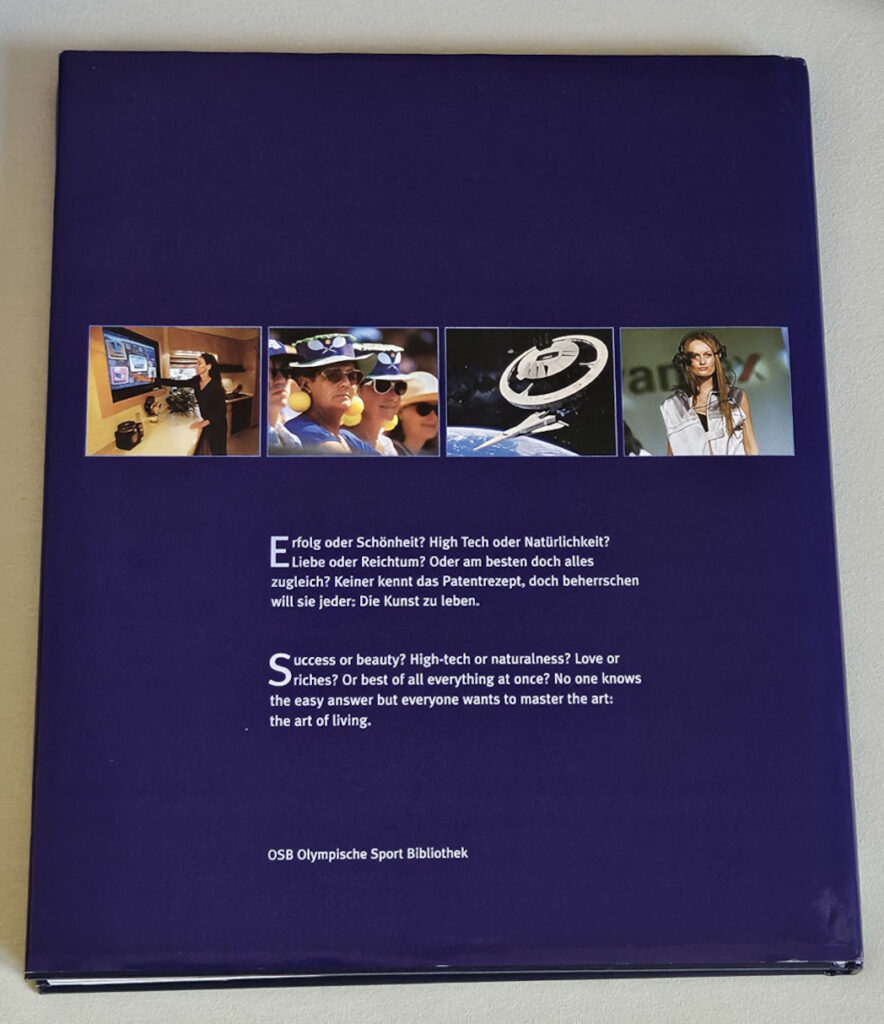
Reading them, some deal with truffles in Umbria, ways to self-optimize oneself and one’s company, the right time to enjoy one’s life and rather different topics like space tourism, houses of tomorrow, and brand marketing. The pictures gracing the front and back cover of the book show twice smart houses, space travel, body painting (from one of the more mysterious chapters dealing with letting go of problems though e.g. body painting), good living, ways to calm yourself down and so on. To be honest, the pictures look more seamlessly fitting together than the written chapters.
We will jump into the brand marketing chapter first, as the lessons learned there resonate with people with a certain experience in life. The chapter was written by Dr. Klaus Brandmeyer, a famous German brand expert, who died a year ago. He took the example of the tennis tournament of Wimbledon for a brand that everybody knows and that can dictate rules even to very famous players. The point he made is that all strong brands are ‘self-similar’. This means they are not strictly identical to what they did before, but stick to certain key identification features. Deep in the unconsciousness of the human mind everybody seems to like people/companies/etc that stay true to themselves, meaning self-similar. A lot of people/companies do not have the strength do stand this through, but we admire those who do. Self-similarity means familiarity and that is the precondition to trust. Trust is extremely mighty and can win over the best arguments made by someone who is only a stranger.
Dr. Klaus Brandmeyer quotes Oscar Wilde at the end of his chapter “only appearances never deceive” (page. 140). Somehow this says it all, and not only for brands, but also for human relationships – having made good experiences with someone/something is the start and then the brand, be it a single person or a company just needs to make sure they stick to a certain level of self-similarity and do not contradict themselves.
What AI is going to do to classic forms of marketing is not yet clear, but experts say it will change everything. If that is really true, even in the field of self-similarity, we can now supervise in real-time.
Same goes for another very interesting chapter, the idea of space tourism. Back in 2001 when the book was written, Space X, Elon Musk’s brainchild, was not even founded. Richard Branson, the founder of the Virgin Group (known for an airline and music), was already active in the aerospace business. Still, the predictions made in the book of space tourism in the year 2005 and the first hotel in space in 2017 were far too optimistic.
In 2025 we see some of the dreams turning reality. Space tourism is now possible for very rich people. Richard Branson was one of the first in 2021. Today’s market leaders in the race to the moon are the companies of Elon Musk and Jeff Bezos. A hotel is still far from today’s possibilities. This chapter reminds me strongly of a book written by German bestseller author Frank Schaetzing in 2009.It deals with the same dreams, predicted to come true in 2025.
Today we know that the most successful private businesses dealing with aerospace come from the USA. Japan, named in “The Art of Living” prominently, is today and important player in conquering the space, but not through private Japanese companies.
The interconnection between official state programs and private space business is one of the most important developments noone outside the aerospace industry really understood till it was reality. NASA would not be able to work without Space X today, and regarding satellites Elon Musk’s company is better equipped than states. I do explicitly not write he is mightier, because a state can always take things from a private business.
The book “The Art of Living” is a very readable piece of contemporary history. Its look into the future of today tackles many important tech topics, some of the predictions became true, some not. The areas to look at were well chosen.
The big questions of each individual’s life, though, stay as unsolved as ever – and this will be the same in another 25 years or in a 100 years. Huge progress has been made in technical developments; but how to deal with personal pressure and how to lead a fulfilled life stay the same big mysteries 1000 years ago.
All rights to the book belong to:
Olympische Sport Bibliothek: Die Kunst zu leben / The Art Of Living – Das Geheimnis von Luxus, Trend und Etikette/Secrets of Luxury, Trends and Etiquette, OSB München, Pro Sport Verlag, Leuchtenbergring 20, 81677 München, 2001, no ISBN as these books are not sold through ‘normal’ channels. Authors as named on page 238: Wolfgang Joop, Dr. Klaus Brandmeyer, Angelika Jacob, Ulrike Luckmann, Britta Mentzel, Michael Schwartz, Wolfgang Spielhagen (editor in chief), Andrea Tapper, Wolf Thieme, Matthias Weigold
Schaetzing, Frank, 2009: Limit, published by Fischer Taschenbuch Verlag, Frankfurt am Main, Mai 2011. Licenced by Kiepenheuer&Witsch Verlag, Köln, 2009, printed in Germany, ISBN: 978-3-596-18488-0
Frank Schaetzing, himself a marketing manager before he turned bestseller author, would have probably liked the book “Die Kunst zu leben/The Art Of Living” very much.