
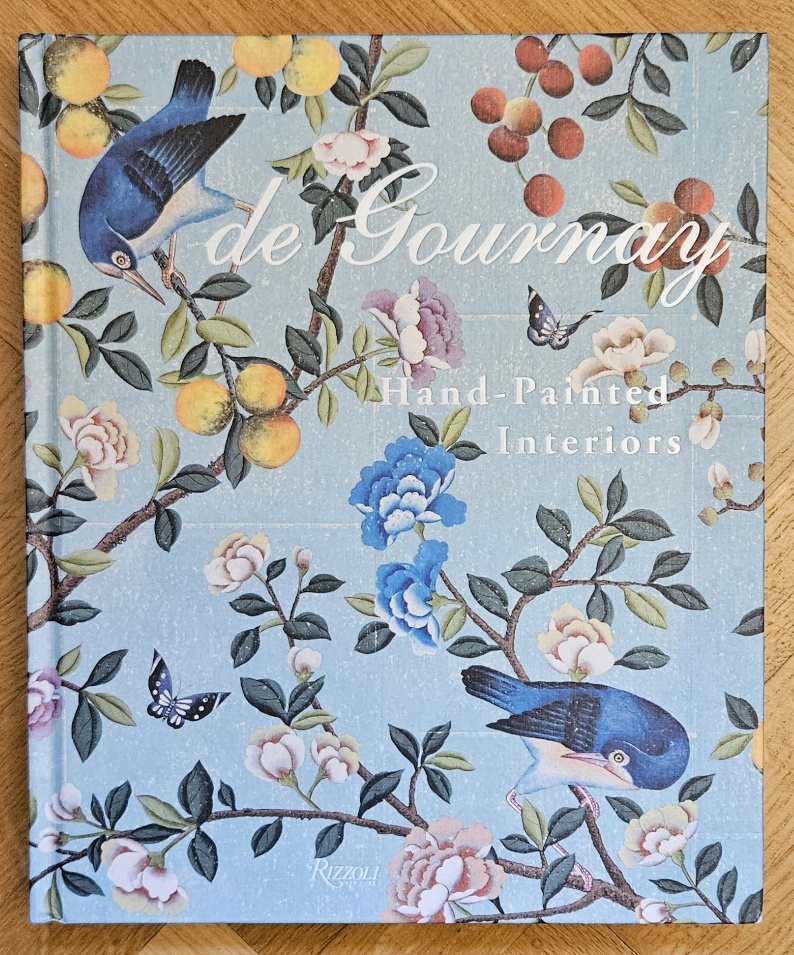
This beautiful book contains surprises. Many of them. I bought the book “de Gournay, Hand-Painted Interiors” mainly because the beauty of frescos, mosaics, and all other form of artfully hand-painted walls or wallpapers in houses are so rarely seen today.
In old castles and medieval palaces often thick tapestries are hung from the walls, but not the walls painted themselves. It was different in Roman times, as can be seen in Pompei and other wonderfully preserved areas in Italy and the Mediterranean. Today we simply paint our walls – in one colour, maybe two, but not more. Not much artistry involved in this. Of course there are some beautiful wallpapers, but they are used mainly in children’s rooms.
Over the centuries, only some gems of houses with hand-painted walls of wonderful landscapes, flowers, leaves, or other decorations came close to the Roman’s art. One of the most breathtaking examples is Palermo’s Villa Malfitana, the former house of the Marsala-wine dynasty Whitaker. Built in the 19th century, its interior walls are almost complete hand-painted and of an exceptional quality.
What does fascinate about hand-painted walls or wallpapers?
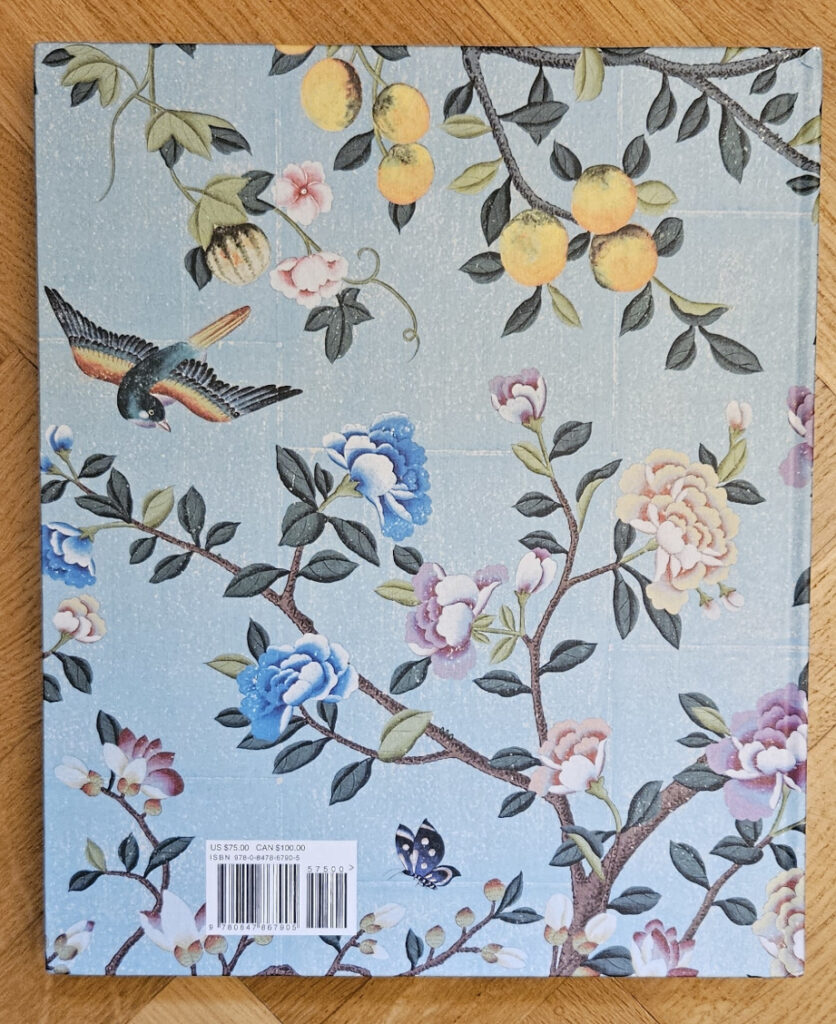
First, the abundance of colour. When you look at the front and back cover of “de Gournay, Hand-Painted Interiors” you see a perfect example of the colour-flash you might get when entering a room covered fully in this decoration.
Second, the celebration of space. If you have invested in a wallpaper like the one seen above, you certainly cannot put other paintings, shelves, bookcases, and other items in that room, if you do not want to crash the look. You must leave the walls blank; they are the attraction, nothing else can compare.
Third, the immersion in another world. Through the wallpaper, the mind begins to wander, or meander, as Claud Cecil Gurney writes. A fully painted room might feel like a secret door to a jungle, to nature, to another world. Probably difficult to have such a decoration in your office where you need to concentrate and work on sometimes boring items.
Fourth, the escape is the exception, not the rule. There is a certain psychedelic spirit to a room like this. In the castles and palaces of old, where one often finds a “Chinese” or “Japanese” room that is very colourful from floor to roof, it is good to get in, and good to get out again.
Reading the book “de Gournay, Hand-Painted Interiors”, and watching the breathtakingly beautiful wallpapers, the immediate reaction is the thought how wonderful it must be to have a house covered in some of the nature-based decorations. Thinking about it a bit longer one comes to realize that a complete house might freak you out soon. Also adding the problem of furniture and storage options. Sparsely dosed, like in a bedroom or in a dining room it can be wonderful. Everyone needs to understand their ability to handle and surround themselves with colour. Colour influences us humans more than we think.
When I bought the book “de Gournay, Hand-Painted Interiors”, I thought it contained the story of an old French dynasty that continued their art against all odds through the centuries. Far from it. The company de Gournay was founded in 1986 by an entrepreneurial Englishman, Claud Cecil Gurney. He chose the name of the company, claiming it was some former French spelling of the family name. Reading his texts in the book and getting a feeling for his spirit, I would guess he named it after Vincent de Gournay, a French philosopher of the 18th century. He shaped the concept of “laisser-faire”. Be it as it may, de Gournay is a new company with no old roots.
Claud Cecil Gurney did not write much about his family, but they were able to give him a very good education and a wide network of family friends that made his start in life easier. He commenced his career at a predecessor company of today’s PriceWaterhouseCoopers and learned his first lessons in practical economics. He stated in his book that the idea to go to China and produce hand-painted wallpapers originated from his wish to have some at his own house. When looking for them, he only got very expensive ones. He then thought that the newly opening-up China (it was the mid-80s, the time of Deng Xiaoping) would be a perfect place to produce his wallpapers. The assumption was that labor was cheap and the skills of the workers were supposed to be good. The latter proved to be wrong, and only after some manoeuvrings could Claud Cecil Gurney successfully set up his studios in China and got perfect quality product back.
Today, the company is justified identified as on of the leading companies for hand-painted wallpapers worldwide. There are older ones around, and more than I thought, but de Gournay has set its mark. Claud Cecil Gurney gave us a breathtaking coffee-table book, better than any advertising catalogue.
The beauty coming with a room that feels and looks like a secret garden in your house cannot be overrated. It is a sign of luxury, as it renders the walls in a room useless for other purposes. Having one such room in an apartment or a house is comparable to a holiday or a spa retreat or a long mediation.
Bringing an image of perfect nature in soothing colours, especially green and blue, to your home and using it for your inner escape, might be one of the best ideas in your life.
All rights to the book belong to:
Gurney, Claud Cecil: de Gournay, Hand-Painted Interiors, 2020, published by Rizzoli International Publications, Inc. 300 Park Avenue South, New York, NY 10010, printed in Italy, ISBN: 978-0-8478-6790-5