
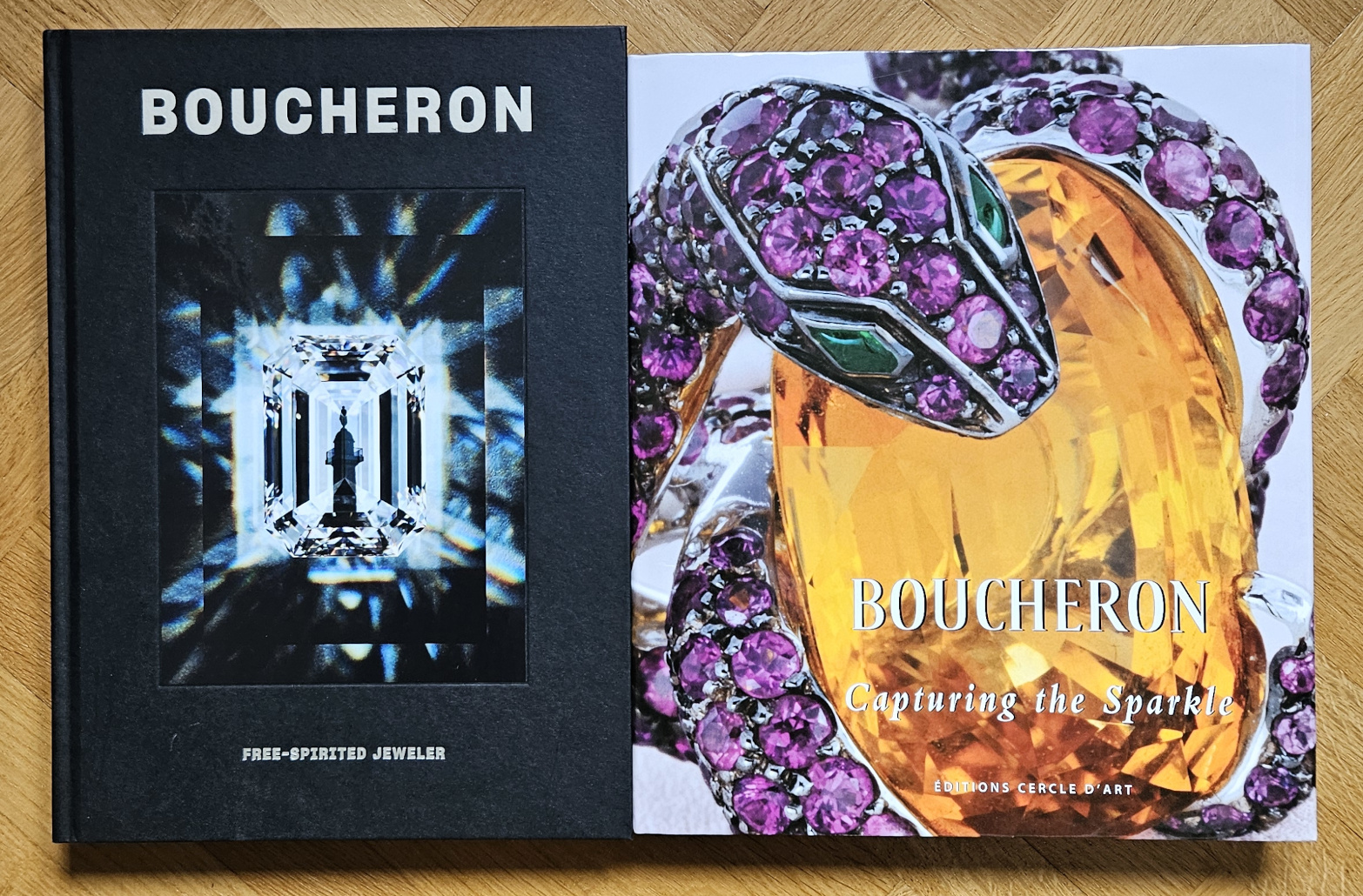
When flipping through the 3 very different books on famous high jewellery house BOUCHERON, I came to the conclusion that connecting all of them was BOUCHERON’s artistic and cultural independence from Europe. The clients of BOUCHERON were for the most part not the royal houses of Europe, or the conservative high aristocracy, but more vivacious and exotic people like courtesan’s, heiresses, and royal houses from the Middle East and Asia. The overwhelming spirit of the BOUCHERON jewels is shown through colour, form and flexibility. Of course there are pure diamond jewels, but if so, the way they are combined gives some lightness. Or the texture of the stones is different, like in the ‘Hiver collection’ of 2017. What also sticks out is the upkeeping of tradition in the house of BOUCHERON. Maybe not throughout the entire history, but today’s jewels are in creativity a lot like those of the founder Frederic Boucheron.
“Archives secrets BOUCHERON”, was written by author Vincent Meylan. It is not his first book to be discussed here. He is an expert on royal jewellery, French jewellers and on famous collectors of jewellery. In total, he is an institution on jewels and every book created by him is worth reading for someone who loves jewellery. Vincent Meylan got direct access to BOUCHERON’s archives. For a while in the 2000s he wrote fantastic books on France’s most prestigious (maybe not most famous) jewellery houses like Mellerio dits Meller, Van Cleef & Arpels, and BOUCHERON. I bought them directly after publication and read them in French, a tedious task, but the option of missing out on those stories was just too deterrent.
The other 2 books are creations by BOUCHERON. Whilst “FREE-SPIRITED JEWELER” shows on the title page a classical white diamond reflecting a statue on Place Vendome (BOUCHERON was the first jeweller there), “Capturing the Sparkle” bows to the often-whimsical details of BOUCHERON jewels. Its title page gives details of the “Pythie” ring, pictured in full on page 72 of the book. Both books have their strong points. “FREE-SPIRITED JEWELER” shows various collections in a deep-dive and the family history of BOUCHERON, whilst “Capturing the Sparkle” tries a more artistic approach with author Anne-Marie Clais. “FREE-SPIRITED JEWELER” was written in 2018 when the new management in BOUCHERON was already in place for a while, and elegantly closes the circle between history and present.
Frederic Boucheron (1830-1902), the founder of the company, was certainly a visionary person. He invented some new styles of jewels and ways of wearing them. One of the most enduring is the ‘plume or question mark’ necklace that does not need a clasp. It snuggles itself elegantly around the neck of the lady wearing it, being open in front and therefore flexible enough to put it on.
Frederic Boucheron, the founder of the company, became during the 19th century one of the most beloved jewellers for the then really famous courtesans in Paris. The most important client was La Paiva, later Pauline von Henckel and Donnersmarck. She must have been a really smart lady, becoming rich long before she managed to marry an extremely wealthy Earl. Her husband was from a very conservative German aristocratic family and he adored her, something that was basically unthinkable at those times (and even today the liaison would have raised eyebrows). The saying goes he had her body conserved in chemical liquid after she died, to be able to gaze at her. Her jewels, or at least some of them, are still around. Hers were important stones and clear designs, but also in varying colours. BOUCHERON jewellery never looks boring and just expensive, it always adds a special touch.
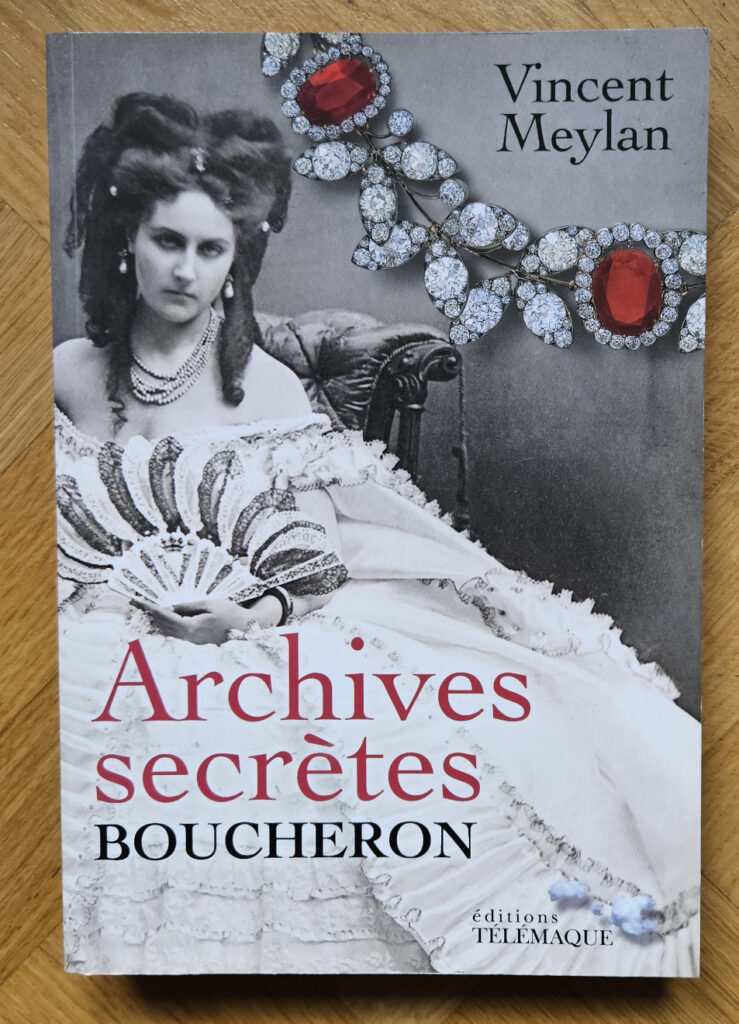
Vincent Meylan’s book shows on its front page another courtesan, the countess of Castiglione, wearing BOUCHERON jewellery. She was emperor Napoleon IIIs lover for some years. Unfortunately, the picture does not really transport the charm of the lady. The book’s title page also shows details of a beautiful diamond and ruby necklace belonging to Mona Bismarck, who lived almost a century later, but also came to money and fame through her beauty.
During the 20th century the most fascinating customers of BOUCHERON were from Egypt, Iran and India. The house had by then passed to Frederic’s son Louis (1874-1959). The Egyptian royal family is today more or less forgotten, but in the 1930-1950 they were famous names. Princess Fawzia, sister of the Egyptian king, was one of the most beautiful women ever and also the first wife of the Shah of Iran. She hated Iran and the family of her husband – back in Egypt she was happier and stayed there, even after the dynasty was toppled. For BOUCHERON the Iranian imperial house was a very special client – at one time in the 1930s they go the order to classify all Iranian state jewels and build a museum for them. It is still there in Teheran at Melli bank – or so one hopes, with the current war raging.
In the years after the Second World War, Gerard Boucheron and later his son Alain Boucheron took over the family business. The style of the jewels became more typical Western. With Alain the line of Boucheron family owning the company ended and today Kering, the global luxury brand is the owner.
The collections shown today by BOUCHERON draw often on the past. Creative Director Claire Choisne states on the BOUCHERON website that she wants to keep the spirit of Frederic Boucheron alive – a very good idea. She holds her position since 2011 – a clear sign that what she does makes sense. CEO of BOUCHERON is today as well a woman, Hélène Poulit-Duquesne. She came to BOUCHERON in 2015. With those 2 ladies in charge, BOUCHERON completed the circle back to the playful and impressive jewels that Frederic Boucheron had introduced.
Each year one can see a lot of them paraded prominently in Cannes during the film festival – a wonderful occasion to see to what heights inspiration has soared and a magnificent sight that would have made Frédéric Boucheron proud.
All rights to the books belong to:
Meylan, Vincent: Archives secretes Boucheron, 2009, Editions SW Telemaque, 7 rue Perignon, 75015 Paris, Conception graphique et maquette: Pierre Duclos, printed in Italy, ISBN: 978-2-7533-0100-9
BOUCHERON: Capturing the Sparkle, 2005, Editions Cercle d’Art, Paris, texts: Patrick Wald Lasowksi, Anne Marie Clais, photographs: Guy Lucas de Peslouan, printed in Italy, ISBN: 2 7022 0797 9
BOUCHERON: FREE-SOIRITED JEWELER since 1859, 2018, Editions de La Mariniere, an imprint of EDLM for the Original and the English translation, texts: Anita Coppet, editor: Nathalie Chapulis, distributed in 2018 by Abrams, and imprint of Abrams, printed and bound in France, ISBN: 978-2-7324-8891-2