
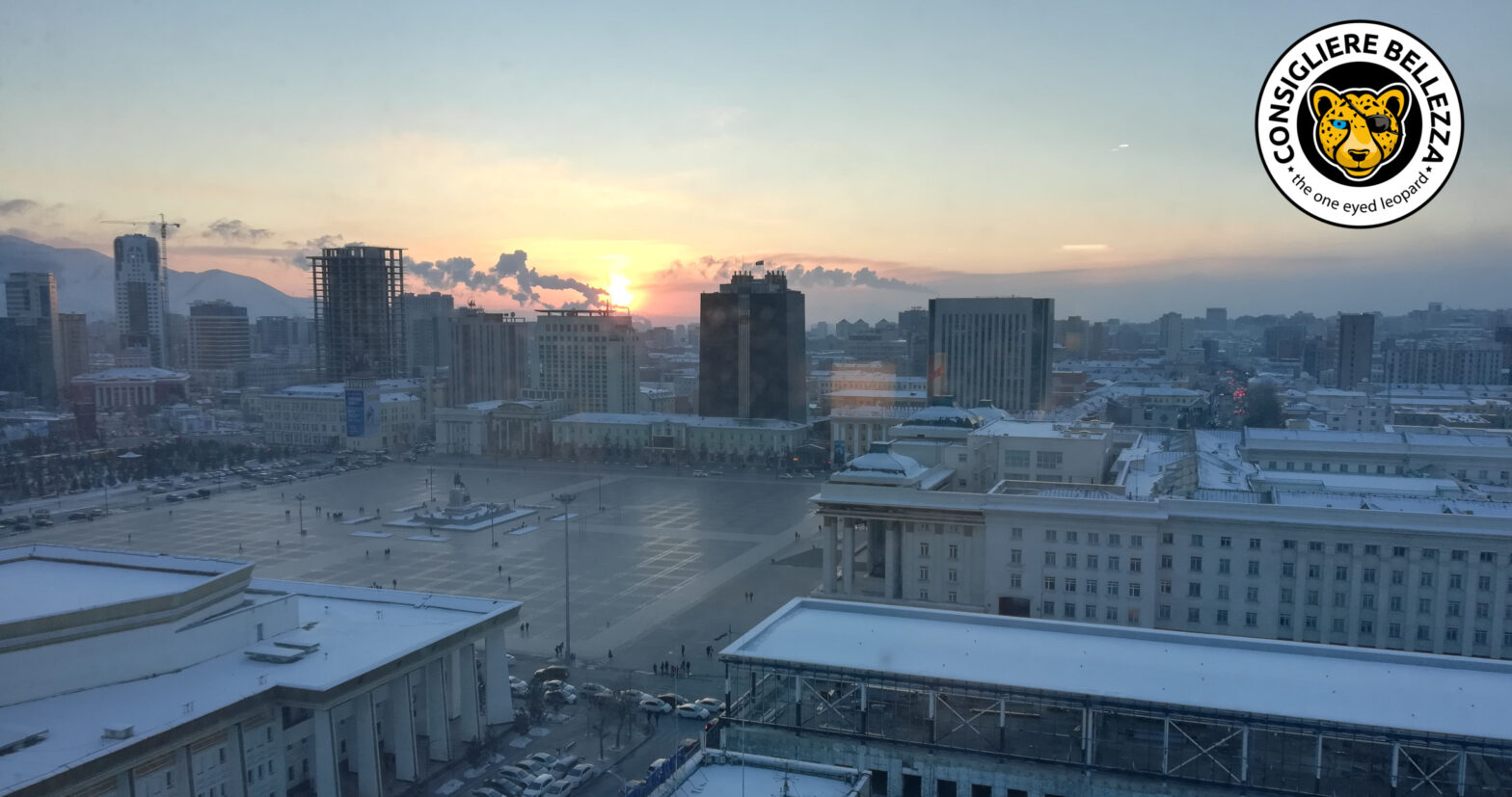
There is little literature on the country of Mongolia, apart from travel guides and books about Genghis Khan. Sometimes the country is mentioned in connection with Marco Polo’s travels, when China was still ruled from Mongolia. During Marco Polo’s time, Genghis Khans grandson Kublai Khan ruled the empire.
Modern Mongolia, captured between the landmasses of China and Russia, has always been hidden from closer world view. The country is big, the 18th biggest country on earth, 4times the size of Germany. After the fall of the Soviet Union it decided to become a democracy and it stayed a democracy, the only one in Asia. All its direct and indirect neighbours are non-democratic countries of different hues. Mongolia is landlocked, a reality that created a lot of problems for the country.
Mongolia is the independent state with the lowest average temperatures (-4 degrees) and the scarcest number of inhabitants compared to its size. There is only one easy way to come – by plane, mainly from China now, since the Russian-Ukrainian war made connections through Moscow problematic. Looking out of the plane window, one is overwhelmed by the vastness of nature without any city or infrastructure. The feeling gets scarier when travelling in country by car to some place. Outside of Ulaanbaatar, only the gers, the typical tents of old, appear suddenly somewhere in the landscape. Single nomads, or a family, travel and make a temporary home with their ger 100s of kilometres away from any other living being, in one of the most hostile environments for survival you can find on this planet. Extreme cold, mountains and the desert mark a big part of Mongolia. There are a cities spread across the country, but they are very far apart and few in total. The only major national road crosses Mongolia from north to south; it is only single track. To reach most destinations one goes by car cross-country, sometimes aided by GPS, sometimes only be the orientation sense of the Mongolian driver. More infrastructure has been developed by the big mining companies in the south, but that is usually not for passenger transport, but for goods. The same goes for the railway lines. The big one is the Mongolian part of the Trans-Siberian Railway, ending in China. This one also transports people. The smaller train lines, the new ones, are mainly for goods like coal from Mongolia to China. The use a different track width than the Russian railways.

Mongolia with its vast distances and the life-forbidding conditions is not for the faint hearted. The country is still as far removed from mass tourism as a beautiful destination can be. Once you have been there in winter at -30 to -40 degrees you know that you could only survive there alone for 2 hours maybe. In Mongolia they say there are only 2 seasons: July/August and winter.
The Mongolian Nomadic culture is very much alive, at least in the spirit of the people. By now almost 1,5 million of the 3 million inhabitants of Mongolia live in the capital Ulaanbaatar, looking for an easier life with more chances in the city.
The country is changing, with more and more people visiting and new options coming up through tourism and construction. I was lucky to start traveling to Mongolia from the early 2000s. There are, as always, pros and cons for change: The food selection became much better over the years (in the beginning the smell of cooked mutton was everywhere), but the individuality of the country, especially of Ulaanbaatar became less. By now a foreigner does not need to adapt to many new things when he/she comes to the big city. Of course this ends immediately at the border of the city. Outside the city nature rules without any restrictions.

Michael Walters 3 crime fiction books are a beautiful memorial to the Mongolia of the early 2000s, when the country had opened up for some years but was still not crowded by foreigners trying to make money. The mineral resources of the country had been taken notice of and some adventurous foreign players had started operating in the deep south or around Erdenet. Back then, Mongolian politicians still hoped with a lot of honest energy for a “3rd way” for Mongolia, without China or Russia being involved.
Today Ulaanbaatar spots luxury hotels and more and more memorials get erected for the glorious past under Genghis Khan. Back then, he best hotels were the perfectly central Corporate Hotel and the further out Kempinski. The Bayangol Hotel, owned by a business man who later became President of Mongolia, had been there even longer, but has always been rustic and very Mongolian when it came to food.
The 1st of Michael Walters books, “The Shadow Walker” starts in the Bayangol Hotel, where the 2nd murder victim is found. I love the 1st book most – the mixture of the mining camps in the south, the awakening city and the great characters, mainly Inspector Nergui and Doripalam, let the 2000s in Mongolia come alive. The other 2 books, “The Adversary” and “The Outcast”, are about the post-Soviet new businessmen caught between honest optimism and criminality, and the country’s mounting political problems, caught between China and Russia. The plot is carefully crafted, but it is not what makes the books exceptional.
Michael Walters wrote and published the Mongolia books in 3 consecutive years, 2006-2008. He stopped then and turned his attention more to his home region in the UK, under the pseudonym Alex Walters. It seems he did well with his books. He abandoned a 4th Mongolia book a few years later. His 3 books are of a high quality when it comes to authenticity. Better to end the adventure than to deliver a book not up to the former standard.
A French author also had success with books on Mongolia during the last years. All that is not for me. For a true glimpse in the young Mongolian democracy with the mixture of nomadic life and nomadic values confronted by the chances of huge wealth through mineral resources, Michael Walters has got it best. If you want to understand about the country, especially the changes, reading those books will give you more insight than any TV documentary or tourist guide.
Mongolia will never fully succumb to any outside power or lose its nomadic spirit. The Mongolians are proud people and no one has forgotten that once they had ruled half the world.
All rights to the books belong to:
Walters, Michael: The Shadow Walker, 2006, first published in Great Britain by Quercus, 21 Bloomsbury Square, London, WC1A 2NS, ISBN: 1 84724 080 1, ISBN-13: 978 1 84724 080 4
Walters, Michael: The Adversary, 2007, first published in Great Britain by Quercus, 21 Bloomsbury Square, London, WC1A 2NS, ISBN (HB): 1 84724 059 3, ISBN-13: 978 1 84724 059 0, ISBN (TPB): 1 84724 060 7, ISBN-13: 978 1 84724 060 6
Walters, Michael: The Qutcast, 2008, first published in Great Britain by Quercus, 21 Bloomsbury Square, London, WC1A 2NS, ISBN: 978 1 84724 419 2 (HB), ISBN: 978 1 84724 420 8 (TPB)
The Blog “The Shadow Walker” by Michael Walters does not exist anymore.
Michael Walters has now (since 2024) a new website for all his books, written and published exclusively under his pseudonym Alex Walters, at alexwaltersauthor.com (date of use 19th of January, 2025)
I used interview no.562, conducted by Morgen ‘with an E’ Bailey and Michael Walters in 2012 for background information. You can find it on morgenbailey.wordpress.com (date of use 19th of January, 2025)
I also used Jeff VanderMeer’s Publishers Weekly article/interview with Michael Walters. It was published under the title “Mongolian Noir” on 06/30/2008. Date of use 19th of January, 2025.