

The brand Parfums du Chateau de Versailles is dedicated to revive the life of the Franch royal family and palaces in the time before the revolution, especially the court of Louis XIV, the “Sun King”. He was the longest ruling monarch of French royal history (1643-1715) and became the definition of an absolutist monarch. “The State am I” was one of his most famous quotes. Quite openly, such a man was not content with his wife, but had official and unofficial mistresses.
His last one, and his deepest love, his morganatic wife, was Francoise d’Aubigne, Marquise de Maintenon.
The perfume dedicated to her radiates luxury, smoothness, elegance, and refinement. It is not the perfume of a young girl, as also the Marquise only became his wife in her late 40s.
Spraying it, a wave of soft, warm oud with fresh raspberries, cherries, or roses envelops you. The oud-note is the dominating scent of the perfume, and it smells rich. There is old liquor around as well, and dark chocolate. The fresher rose and fruit notes are also completely feminine. One does recognize similarities to “Oud Satin Mood” by Francis Kurkdjian, but “Madame de Maintenon” is very much a women’s perfume.
The fragrance is for the evening and a grander entrance. In summer during day time, it might feel out of place, except if you need to make a statement.
The scent notes of the perfume, as named in the booklet coming with it, are as follows: saffron, myrtle, bergamot peel, Turkish rose, leather, jasmine, sandalwood, patchouli, amber wood, crystal musk.
The saffron could be the cherry or raspberry that I smell. What is surprising is that any mention of oud is missing in the description. The scent is close enough to a perfect oud, but not as hard as oud sometimes comes.
Strong oud seems to be often beloved by men, and there are intrusive and pungent perfumes about that give oud a bad reputation, at least in my reckoning. I mean the kind of oud you smell whilst not even being in speaking distance to the wearer of the perfume. Oud is best used by master perfumers only.
Nothing of the bad side of oud can be smelled in “Madame de Maintenon”. Maybe the unnamed perfumers of the brand Parfums du Chateau de Versailles made a softer oud-twin out of sandalwood, patchouli, amber wood, and myrtle, catching the soft and beautiful sides of the scent. They created something very special.
The colours of “Madame de Maintenon” are dark brown and a deep, saturated pink.
If there ever were luxurious, lavish, or voluminous packaging to perfumes, then to those of the brand Parfums du Chateau de Versailles. I included a picture of the full set here in the article. Some perfume brands have beautiful and creative packaging, worth collecting. The cases of Parfums du Chateau de Versailles are made like old volumes of books, with a slipcase, a leather-bound book with the perfume inside, and also a small booklet explaining about all the perfumes of the collection. The size of the whole packaging of “Madame de Maintenon” is an astonishing 30x16x10 cm. I kept it due to its extravagance.
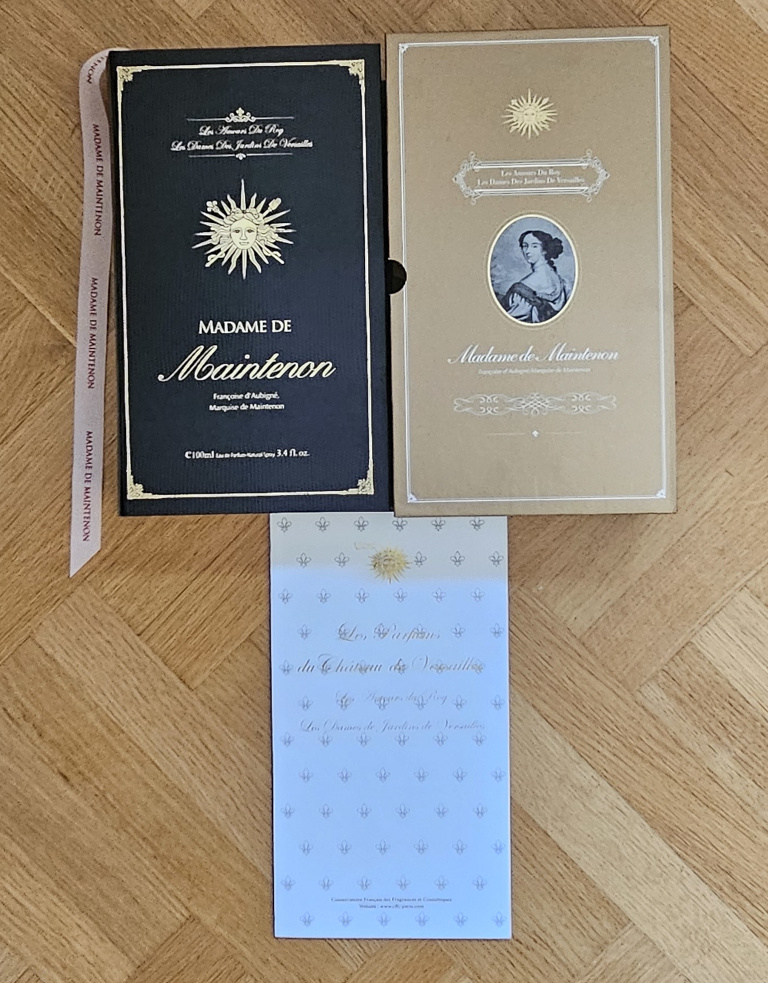
The booklet gives detailed information about the history and the assignment made to the Conservatoire Francais des Fragrances et Cosmetiques (CFFC), Parfums du Chateau de Versailles’ mother company. An official letter by the French ministry of arts from 2011 is included that gives the licence to CFFC to use the name and trademarks of Versailles for the perfumes. It is a little bit surprising that CFFC has strong connections to China.
If the perfume recipes really have their origin in old recipes found in the archives of Versailles, we do not know. Of course that is said in the brand’s marketing story. Body hygiene was during the 1600-1800s very low compared to today and people, even the rich ones, often stank. Instead of using more water, often more perfume was used, for better or worse. How much the then used perfumes had to do with the new ones can here not be said for sure.
Francoise d’Aubigne, later Madame de Maintenon, had been renowned her whole life for her beauty and her looks, but made sure to keep her reputation. After a difficult childhood (she was born in 1635), torn between relatives, religious convictions, and those sides of the family with and without money, she became a discreet young woman. She married playwright Paul Scarron, who was much older and of no physical handsomeness’, but who loved her. He had a decent royal pension and was well connected. She enjoyed the life with him in Paris’ artists circles and learned everything she could, especially the art of conversation, so important to the French. Madame Scarron did not take lovers after the too early death of her husband, even when financial hardship became pressing. Instead, she started to work as a secretary for rich friends, and as a governess to their children. She was a natural in the latter and through connections and luck, the then mistress of King Louis XIV made her the governess of her 7 illegitimate children with the king.
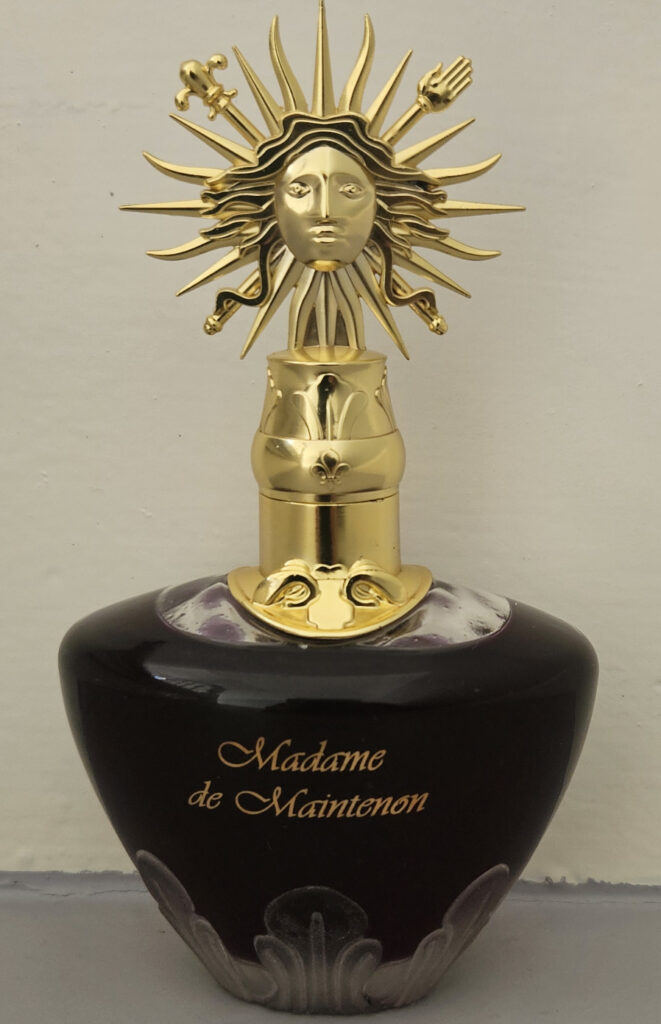
Through her dedicated work, her affection for the children, her wit and her intelligence she became part of the royal court and later on won the prime place in the King’s heart. After the death of his wife, they married morganatic in 1683 and lived a quiet, scandal free life together till his death in 1715. Of course, Madame de Maintenon was later accused by the public, journalists, and politicians of having an evil influence on the king. It seems every king who makes unpopular decisions has as a scapegoat a strong woman somewhere around him, whom the public hates. If Madame de Maintenon had any political influence at all, we do not really know. She lived quietly till her own death in 1719. Hers was a full and an accomplished life.
One can only try to imagine how difficult it must have been to raise from a poor childhood to such heights as Madame de Maintenon did, and stay there. Especially the latter, to stay there. When 100s lie in wait to replace you at the slightest mistake, no misstep is forgiven. It must have been a life full of tensions, as is the price for any position of power. She mastered it, like she was born for it.
The grandezza of the perfume “Madame de Maintenon” sets a wonderful olfactive exclamation mark for that remarkable woman.