

If you want to see and understand the Topkapi Palace without travelling to Türkiye, Ilhan Aksit’s book “Topkapi Palace” is certainly one of the best ways. He was for many long years the director of the national palaces and later continued his career as an author and editor about the national treasures of Türkiye.
Everybody who has been to Istanbul knows the beautiful site of the palace, on the European side of the city, overlooking three waterways merging – the Maramara, the Golden Horn and the Bosphorus. The palace is not very high like European castles, but built in courtyards on a wide range of land.
Aerial views of the palace are especially fascinating, showing the many cupolas and domes. The palace was built during the reign of Sultan Mehmed the Conqueror. Buildings as the Topkapi Palace are never truly completed. During the 19th century, Sultan Mahmut II gave the palace his mark, and only from then on it was known as the Topkapi Palace.
The palace was used as the seat of government till 1853, then became home for ranked officers and since 1924 it is the world-renowned museum we admire today. Ilhan Aksit describes all the 4 courtyards and the famous harem for the wives and concubines of the sultan with plenty of detail, and wonderful pictures of the inside and outside of the buildings. There is not much antique furniture left which comes as no surprise when one thinks of the different groups of people who lived there. The frescos, paintings, and especially mosaics are wonderfully presented in the book.
The front and back cover of “Topkapi Palace” show some of the most valuable items in the collection of the museum. They are all in the treasury part of the palace in the 3rd courtyard. It is a pity the thrones are not shown on the outside of the book, as especially the throne of Ahmet with its walnut wood, tortoise-shell and mother-of-pearl design is very impressive.
The slipcase of the book shows on the front a gold inlaid iron helmet with the monogram of Sultan Süleyman. The delicate relief on the conical helmet, the rubies and turquoises make it look more like a crown than a helmet. That Askit Ilhan made this helmet the first item to be seen by somebody who reaches for the book speaks for itself. The back of the slipcase is reserved for the most valuable diamond in the collection, the so-called spoon-maker’s diamond. Typically for a large diamond of today 86 carats, it was swindled from its finder (for 3 spoons, or so the legend tells). The diamond is set in the Middle-Eastern shape (aigrette) to be used as a jewel worn on a turban by influential men. In this case, without doubt, the sultan.
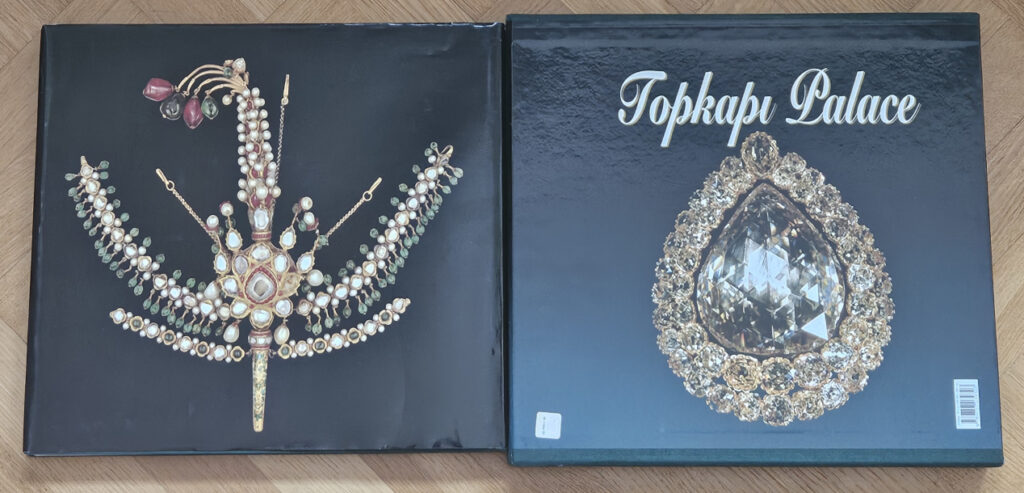
The book presents on its own back cover another aigrette, bigger than the spoon-makers diamond, but also more delicate, in pearls, rubies and emeralds, set in gold. Aigrettes were the oriental counterpart to crowns and medals in European royal houses.
The front cover of “Topkapi Palace” shows the most famous jewel around: the Topkapi Dagger. There are many beautiful daggers in the treasury part, but the one with the 3 large emeralds became the symbol of the museum through the movie “Topkapi”. The dagger is exquisitely done; its golden sheath shows a multitude of diamonds and an unexpected fruit basket. Fruit baskets are also on the other side if the emeralds on the hilt of the dagger. On top of the hilt is a watch – the jewel is a masterpiece.
The 1964 movie “Topkapi” of Jules Dassin is also a masterpiece and the name-giver for the dagger. Ilhan Aksit writes this in “Topkapi Palace” and it is fully believable.
The movie is based on Eric Ambler’s book “The Light of Day”, about a group of master-class thieves and an unlucky petty criminal who is drawn in the robbery. In the book the thieves steal more than the dagger from the Treasury; they are out for everything portable and valuable. All the while the book tells the story of small time crook Arthur Abdel Simpson, who becomes an unwilling part of the group and later brings the jewels back to the Turkish authorities.
Contrary to that, the movie tells the story of Elizabeth Lipp and Walter Harper, the master thieves. Elizabeth Lipp, unforgettably played by Melina Mercouri, is deeply in love with emeralds and makes the dagger her must-have piece. Handsome Walter Harper (Maximilian Schell) is in the film a more sympathetic man than in the book and of course one of the lovers of the lady. He organizes the robbery.
The movie is funny and also exciting, sometimes bordering on slapstick, but absolutely worth watching. Peter Ustinov, who played Arthur Abdel Simpson, got an Oscar for his performance.
The movie, and the book, gave the Topkapi Palace a boost of fame in the 1960s. The Turkish authorities were kind enough to allow filming there. The palace became a World Heritage Site in 1985 – well deserved.
While there are many museums with many beautiful and even more valuable pieces – I dare bet there are few museums made such famous in book and film as the Topkapi Palace.
All rights to the books belong to:
Aksit, Ilhan (editor): Topkapi Palace, 2005, published by Aksit Kültür ve Turizm Yayincilik, printed by Ohan Matbaacilik San, Ltd, Turkey, ISBN: 975-7039-30-6.
In the post I also refer to:
Ambler, Eric: The Light of Day, first published in 1962, here: Penguin Classics 2023, 1st edition, ISBN: 978-0241606193
Topkapi (movie), 1964, directed and produced by Jules Dassin, production company Filmways, distributed by United Artists