
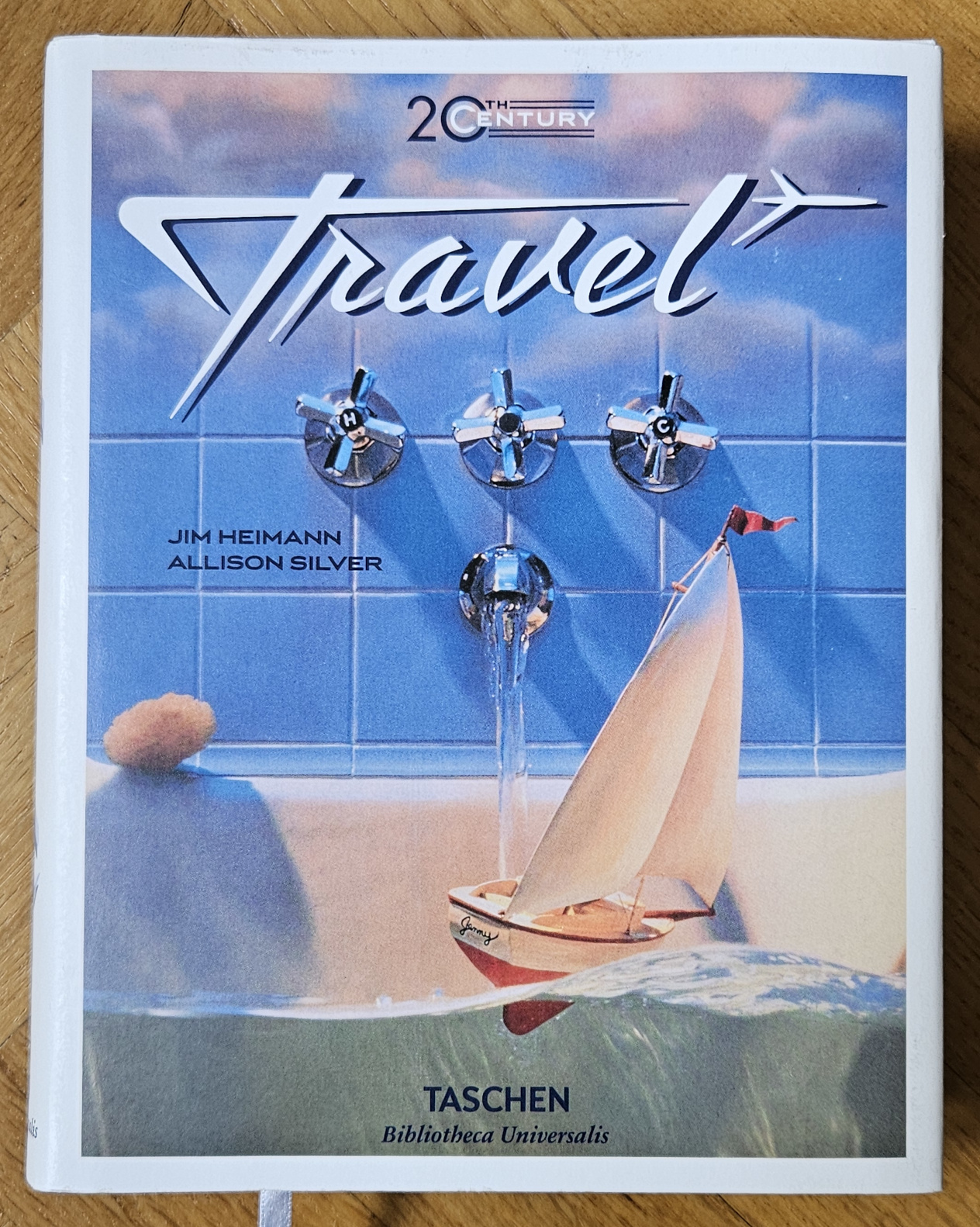
The book “20th Century Travel” by Jim Heimann and Allison Silver makes you dream. Dream of a time much more stylish than ours, made exceptionally obvious through the fantastic painted posters from Jim Heimann’s collection. All chapters are written in English, German, and French, making the book truly accommodating for a wider community of readers.
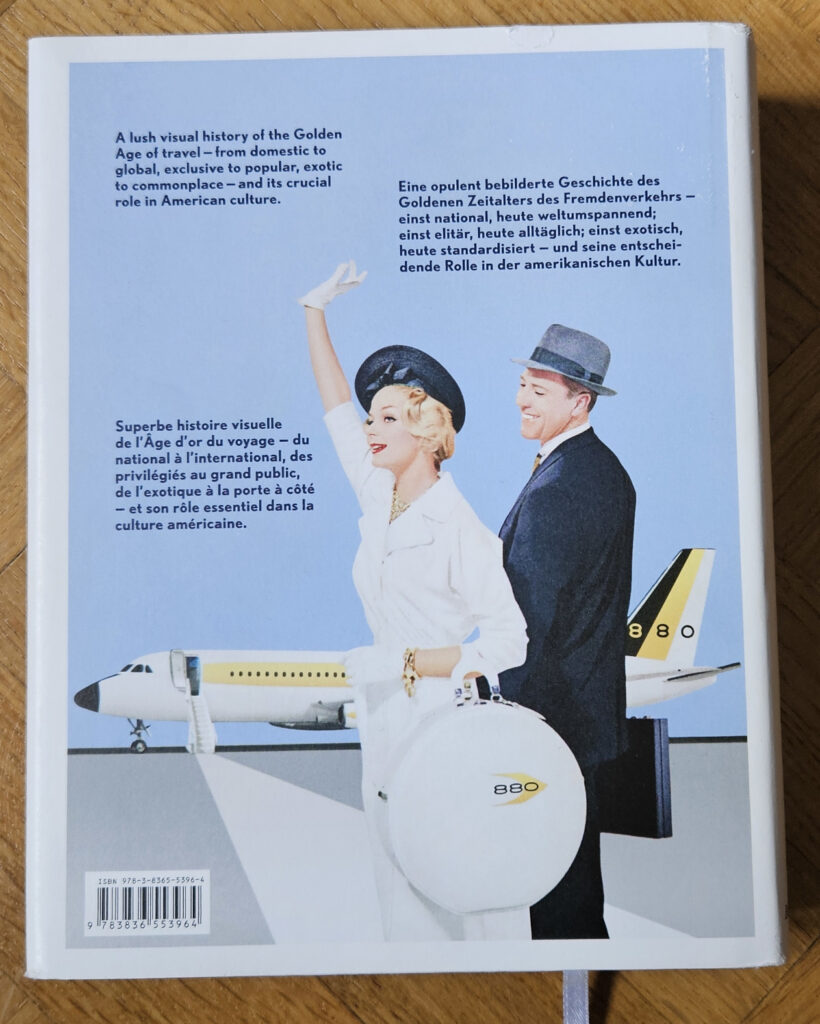
It is a real pity that only the back and the front cover can be shown here, but you get the idea. The colours, the elegance, the creativity of the book gets well represented through both pictures. “20th Century Travel” covers the full last century, from 1900 to 1999. Travel advertisements changed over time, but one would not guess that the front cover is from a 1998’s advertisement of the Holiday Inn hotel chain. The back cover shows the nostalgic style of travel in luxury and with leisure, something connected directly to the time when only the upper class could travel. The poster is from Convair in the year 1960.
The amount of travel in general is defined by the transport available. Transport was scarce till only a few hundred years ago. On land speed was defined by horse carriages for the faster travellers and walking as the normal way to move for everybody else. The possibility to cross oceans already existed; ships had crossed oceans for 100s of years. Through courageous men new parts of the world were discovered. Often travellers stayed in the coastal areas of a new region or continent. A journey like that of Marco Polo in the 13th century from Venice to Mongolia and back was a once-in-a-century event.
Only with the end of the 19th century trains were becoming a commonly used means of transport for travellers all over the world. The worldwide railroad net was still growing every year till well in the mid-20th century. The construction of railroads through the USA had made some people very, very rich; the names of the Vanderbilts and the Goulds are well known. Averell Harriman, whom we have met as the husband of Pamela Hariman in another blogpost, owned most of his fortune to his ownership of the Union Pacific Railroad. Before those individuals had commercialized railroad construction, for almost 80 years, railroads had been built in below 10-kilometre distances and the trains were still steam powered. The importance of railroads and trains was made clear with every war that took place – those with the better rail-network had a clear advantage. Railroads and train companies all started out private in the 1850s – a century later almost all were nationalized.
Cars as a means of transport for individuals were also invented in the 19th century. Henry Ford made them a mass good only in the early 20th century. The workers in a Ford factory could also afford one of the simpler car models. Compared to horse carriages the difference and benefits of a car were crystal clear. Car manufacturing was never nationalized, but road construction generally is even today.
“20th Century Travel” bows to the first transcontinental coaches of the Greyhound Corporation and also the golden age of trains from the mid-1920s to the 1930s. The democratisation of travel was caused by the industrialisation of the economy. More people got work and the old class hierarchy became more and more permeable. More people suddenly had money to spend and an interest to see more than their close surroundings.
At the same moment, time became more and more scarce and important; to get money one needed to work and the concept of holidays was only at the beginning in the mid-20th century in Europe and the USA. Holidays tend to expand when a nation’s middle class gets bigger. The last country where you could observe a sudden increase in public holidays was China. In the 1990s and early 2000s, when the country stated its own industrial revolution, people in China seemed to work almost 24/7. Today, however, there are numerous (statutory) holidays that supplement the still-limited number of vacation days.
The biggest impact on the long run on travellers and holiday makers had planes. The possibility to overcome huge distances in hours instead of weeks or months made travel and the chance to see the world real for many people. This development started in the 1950s and 1960s and continued till a few years ago. The price of a plane ticket before the COVID pandemic in 2020 and even today is often cheaper than one for a train, although a plane covers the distance of the trip faster. After the Covid pandemic travel did become more expensive and also the availability of tickets and hotel rooms changed. We will see how that plays out in the long run. Coaches stayed in general very cheap compared to all other means of transport.
Whilst ships had been the earliest means of travel for bigger distances, their importance had declined significantly with the rise of planes. They came back full force as huge swimming hotels. Cruise ships became one of the most significant trends of the turning 20th century. The aim was no longer to arrive somewhere, but to stay in a huge swimming hotel with all animation possible (from sport to opera) without leaving the ship. To be able to see some beautiful foreign cities was often more an add-on than the reason for the trip.
Jim Heimann and Allison Silver state convincingly that the length of a stay in a foreign country / a foreign continent was at its longest at the beginning of the 20th century. The more the century progressed and the more travel was democratized, the shorter the stays became. Travel became more hectic. The climax of this trend is not in the scope of the book, but we all saw it shortly before the Covid-19 outbreak. Venice, as an example of a city with only 43.000 inhabitants, had 30 million visitors in 2019. The travel industry had made an unhealthy turn into cheap mass holidays.
After the Covid pandemic and with the following energy crisis through various wars, travel will probably never become as cheap and crowded as in the 2010s again. During the last years the trips often became longer and sometimes included working from a foreign city instead from the office, combined with a few days holiday. Many people go now on holiday with their camper van to stay independent.
We should be grateful for those changes and travel with more mindfulness and posture again. Jim Heiman and Allison Silver do mention of all people Pamela Harriman, the leading lady of a post a few weeks ago, as the symbol for the end of classical travel (page 426) with her death in the Hotel Ritz in 1997.
The authors published the book in 2010, so they could not see the changes to the travel industry after the Covid-19 pandemic. Probably they would have welcomed them.
Travel with mindfulness and elegance gives back a lot – to the traveller and the countries they visit. The posters in the book give the impression how travel should be and probably, in reality, never was. We still long for it.
All rights to the book belong to:
Heimann, Jim / Silver, Allison: 20th Century Travel, 2016, original edition 2010, published by TASCHEN GmbH, Hohenzollernring 53, D-50672 Köln, printed in Slovakia, ISBN: 978-3-8365-5396-4