
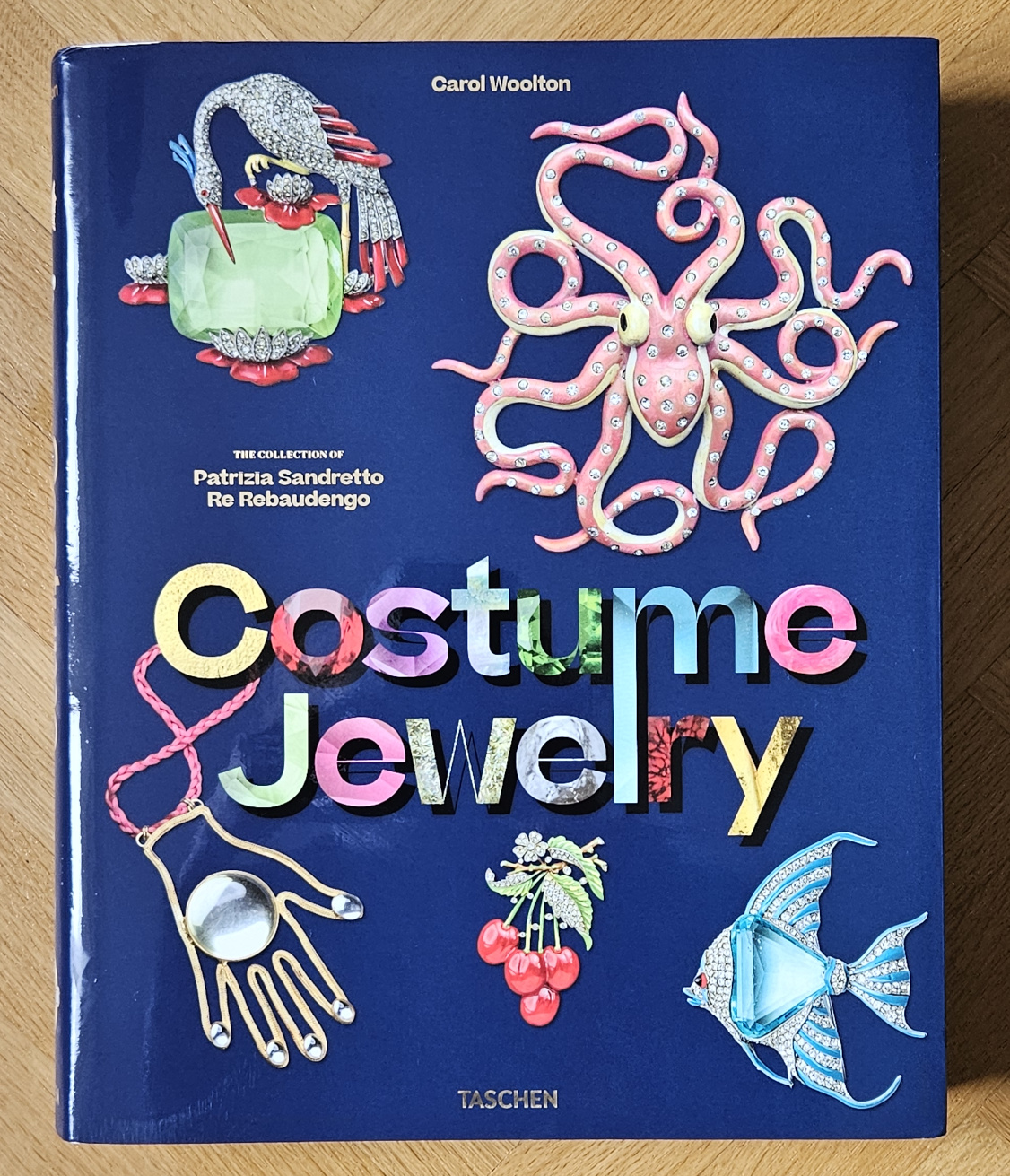
The wonderful-to-behold coffee table book “Costume Jewelry – The Collection of Patrizia Sandretto Re Rebaudengo” by Carol Woolton is a real eye catcher. Everything fits – the owner of the collection, the author of the book, of course the collection itself, and also the publisher. If you are searching for fascinating art books, TASCHEN is one of the regular suspects for creating such books. They work under the motto ‘books for optimists’ and that is true here again. The book comes in three languages, English, French, and German. As the book is written in American English and the post in British English, please be not surprised about the different spellings.
Many of us probably started buying fashion jewellery before being able to afford real gemstones, gold, or pearls. And quite a few of us understood after a while that especially brooches, ear clips, and also sometimes pendants are more available and sophisticated in the costume jewellery world.
Patrizia Sandretto Re Rebaudengo started collecting costume jewellery in the 1990s, and certainly not for money reasons. She was born in 1959 and came from a rich family. Her marriage to an aristocratic family in Turin with the melodious name Sandretto Re Rebaudengo made her a completely financial independent art collector. Although she studied business, she became a perfect art maven with the very special sense of which new artist will become a star, whilst others disappear. She started her Sandretto Re Rebaudengo Foundation during the 1990s, after a few years of collecting. She became its president and still is today. As the focus of this post is on her costume jewellery collection and not the art she collected, we will leave it at that. One can summarize that Patrizia Sandretto Re Rebaudengo created a place for herself far beyond what was given to her by inheritance. This differentiates a really intelligent person from someone who just administers or consumes wealth.
Her costume jewellery collection contains pieces of well-known designers and also unknowns. The golden age of classical American fashion jewellery were the years between the 1930s to the 1980s, although even today one can buy wonderful new pieces in the USA and all over the world. Carol Woolton, who is a well-known name in the jewellery book industry, did a very good job showing the complexity and vastness of the collection of Patrizia Sandretto Re Rebaudengo. Books by Carol Woolton are safe blind buys. If you love jewellery and collect coffee-table books, hers need to be in the collection. I issue a warning – they became heavier and heavier over the years. This one weights clearly a few kilos.
“Costume Jewelry – The Collection of Patrizia Sandretto Re Rebaudengo” gives an overview about all kinds of jewels collected by Patrizia Sandretto Re Rebaudengo. Quite typical, brooches dominate. Brooches are perfect as costume jewellery. As the owner of the collection likes necklaces and especially those of her favourite designer William de Lillo, the book shows many of them (big and bold). Other necklaces by designers like Kenneth Jay Lane, Miriam Haskell, Hattie Carnegie, and Joseph of Hollywood are also given their due in the book.
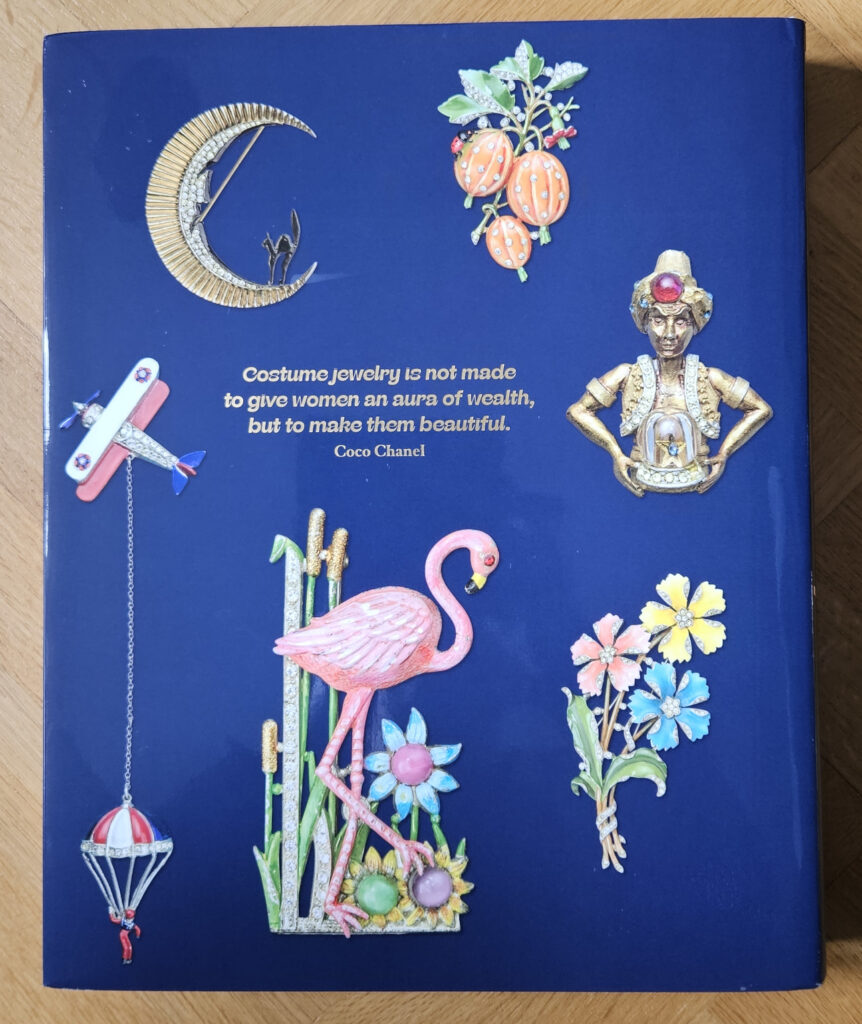
The front and back cover of “Costume Jewelry – The Collection of Patrizia Sandretto Re Rebaudengo” by Carol Woolton shows brooches. On the front cover, I would like to point out 2 by Trifari. Trifari is the best-known American brand for fashion jewellery during the mid-20th century. Both brooches are pretty typical, an angelfish in turquoise-blue and a stork drinking from a greenish pond. Often stones like the aquamarine and the crystal dominate in Trifari’s (and its designer Alfred Philippe’s) creations. Trifari also did wonderful things with enamel. Another very impressive brooch is the octopus by designer Marcel Boucher (company of the same name). He did perfectionate the work with enamel. This can also be seen at the back cover. There is another brooch by Marcel Boucher, a black enamel cat standing on a crescent moon.
For Patrizia Sandretto Re Rebaudengo it does not matter whether the pieces in her collection are designer made. There are also items of unknown artists, e.g. the brooch at the back cover, showing a man jumping with a parachute from a plane. Another one is the big enamel flamingo brooch with colourful flowers. Of course, the unknowns cannot be dated, but also those made by designers sometimes cannot. Fashion jewellery is not always made in larger quantities than cheaper mass market jewellery made from silver or simpler gold (9k or similar), so this is not the reason. The documentation in a shop is – logically – for both kinds of jewellery less laborious than for an once-off high-jewellery piece costing serious money.
It is a very endearing trait of Patrizia Sandretto Re Rebaudengo that she wears the pieces in her costume jewellery collection and does not place them in a safe. Page 497 and 498 give a glimpse of how she stores her collection. Brown boxes with a picture of the content outside. She seems to choose almost every day a piece to wear according to her mood. That is how jewels should be treated, faux and real ones. They should be a pleasure to their owner and they should be worn and seen. Elizabeth Taylor did the same with her very valuable collection of real jewels. People who place heartbreakingly beautiful things in a safe for their money value only are poor in spirit. They lack feeling and intellect. Beautiful things are here to inspire.
Carol Woolton’s book “Costume Jewelry – the collection of Patrizia Sandretto Re Rebaudengo” is certainly an optimistic book. It is a book about a woman who made much more of her money than most people do. She created something new and preserves it through her Foundation Sandretto Re Rebaudengo. And not only that, she enjoys doing so and also enjoys all the wonderful things she collected. She is a role model.
All rights to the book belong to:
Woolton, Carol: Costume Jewelry – The Collection of Patrizia Sandretto Re Rebaudengo, 2025, published by TASCHEN GmbH, Hohenzollernring 53, D-0672 Köln, printed in Italy, ISBN: 978-3-8365-8826-3